
Login to your account!
Join the World's Largest Web App Marketplace!
Great to see you here!
Let’s set up your account in just a couple of steps.
Forgot password?
Enter your username or email to reset your account.
Agent Gateway: AI Agents for WooCommerce & WordPress (MCP + OAuth 2.1)
By : codemypain Published On Tuesday, September 22, 2026, 12:37 In WordPress

Let AI assistants run your WordPress store, on your terms and your server.
Agent Gateway is the missing production layer that lets AI assistants like Claude, ChatGPT, and Cursor connect to your self-hosted WordPress & WooCommerce site over the open Model Context Protocol (MCP). It ships a spec-compliant OAuth 2.1 server, per-agent permissions, and a human approval queue, so an agent can search your catalog, check stock, and draft an order, but never touches anything you have not explicitly allowed. Everything runs on your own domain. No SaaS backend, no phone-home, no API keys to copy by hand.
Try the live demo before you buy: agent-gateway-demo.instawp.site is a real WooCommerce store with the plugin active. Inspect the live OAuth endpoints yourself: resource metadata (RFC 9728) and authorization server metadata (RFC 8414). Or point any MCP client at https://agent-gateway-demo.instawp.site/wp-json/agw/mcp and watch the whole flow work.
How it works
- Connect. Add your site as a remote MCP server in your AI client. Discovery, dynamic client registration, and the OAuth handshake all happen automatically, with no keys to paste.
- Govern. On a single consent screen you grant each agent only the abilities you choose (
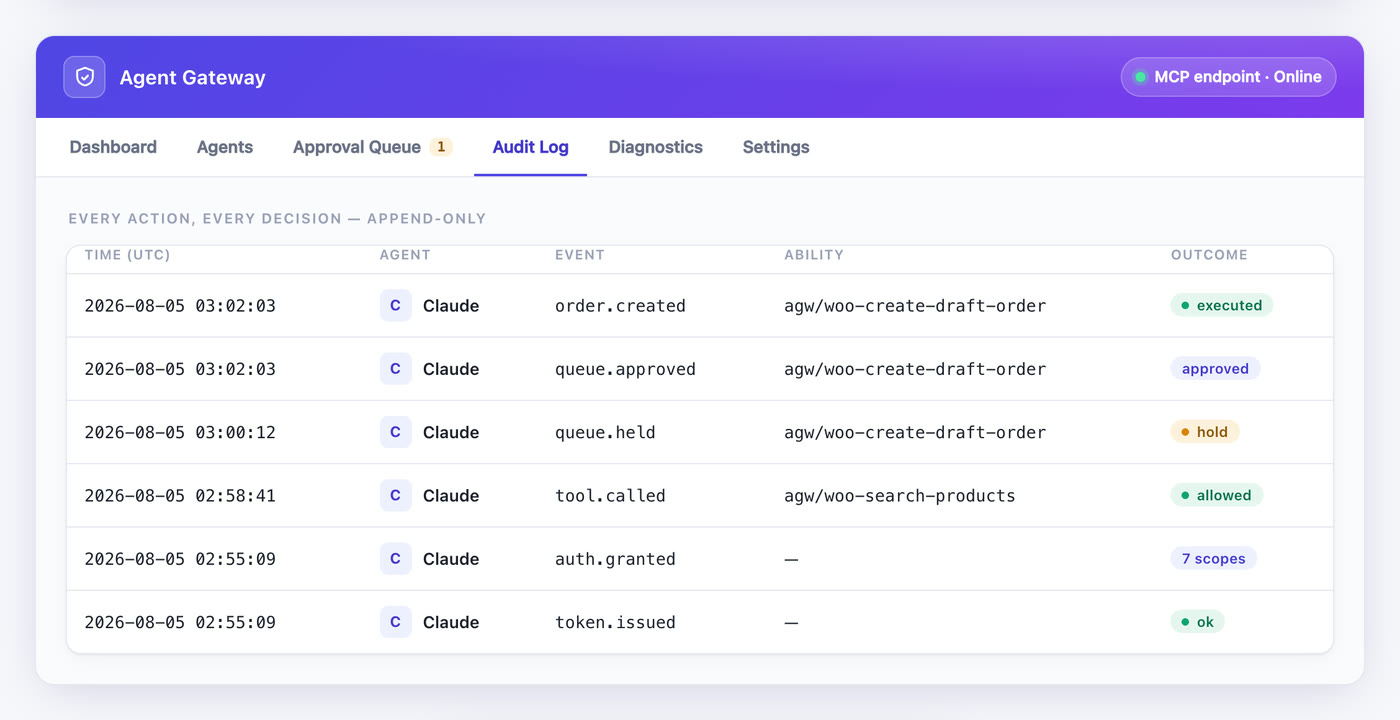
allow,hold, ordeny), with optional rate limits and auto-approve constraints. Change or revoke any of it live. - Operate. Read tools run instantly; write actions wait in your approval queue. Every consent, call, hold, approval, and revocation is written to an append-only audit log.
See it in action
Agent Gateway is not a demo of what AI could do. It is the governance layer for what agents actually do on your store:
- Customer support in Claude. An agent looks up an order’s status for a shopper: read-only, instant, and scoped so it can only ever see the orders attributed to that agent.
- Assisted checkout. A shopping agent searches your catalog, checks live stock, estimates shipping, and drafts an order. It never charges anyone: the draft waits in your approval queue until you say yes.
- Merchandising in Cursor. An assistant bulk-checks stock and pricing while every single call is written to an append-only audit log you can review later.
- Instant off-switch. You revoke an agent mid-conversation; its very next request gets a 401, no matter what tokens it is still holding.
Connect any AI client in one click
Add your site as a remote MCP server in Claude, ChatGPT, or Cursor. Discovery, dynamic client registration, and the OAuth handshake all happen automatically, with no keys to paste. On a single consent screen you choose exactly which scopes each agent gets, and you can change or revoke them any time.
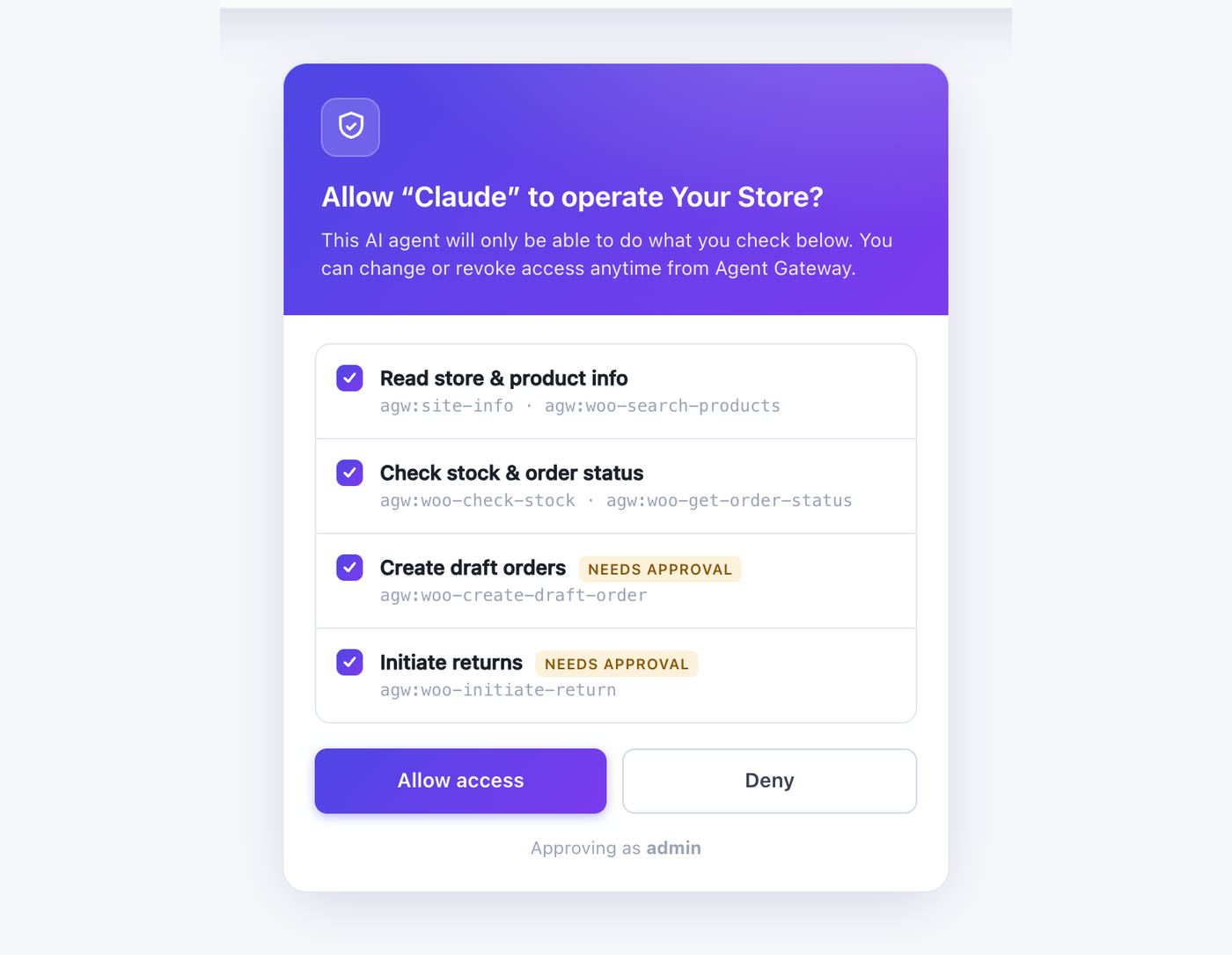
Per-agent, per-ability permissions
Agents are never mapped to your admin account. Each is a zero-capability principal. Set every ability to allow, hold (queue for approval), or deny, add hourly rate limits and JSON auto-approve constraints (for example a maximum order value), and revoke access live no matter what tokens are already out there.
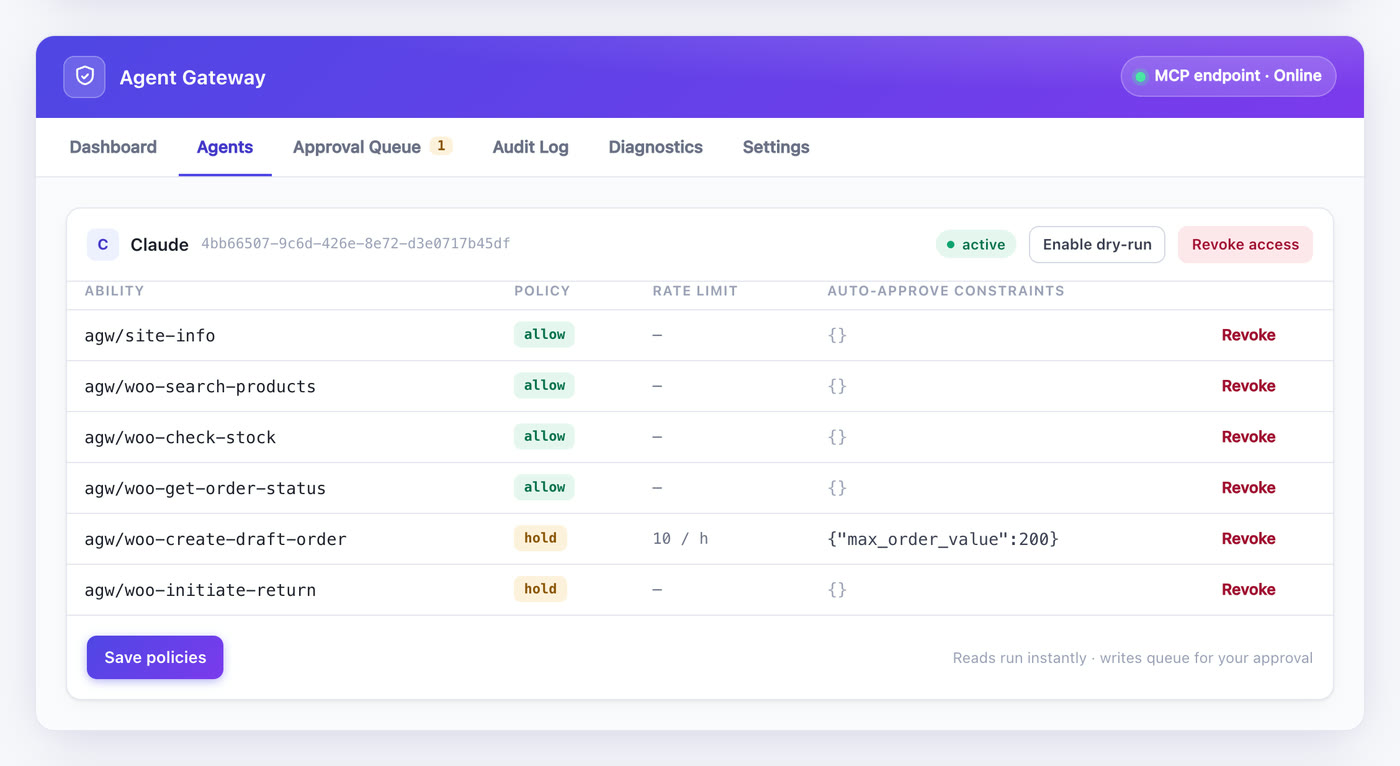
A human approval queue
Write actions can be held for your review. Approve or reject from a clean queue, with constraint-based auto-approval for the routine cases, a global kill switch, and per-agent dry-run mode. Approvals run as the agent, never as your admin account, re-validating the arguments against the current schema before anything executes.
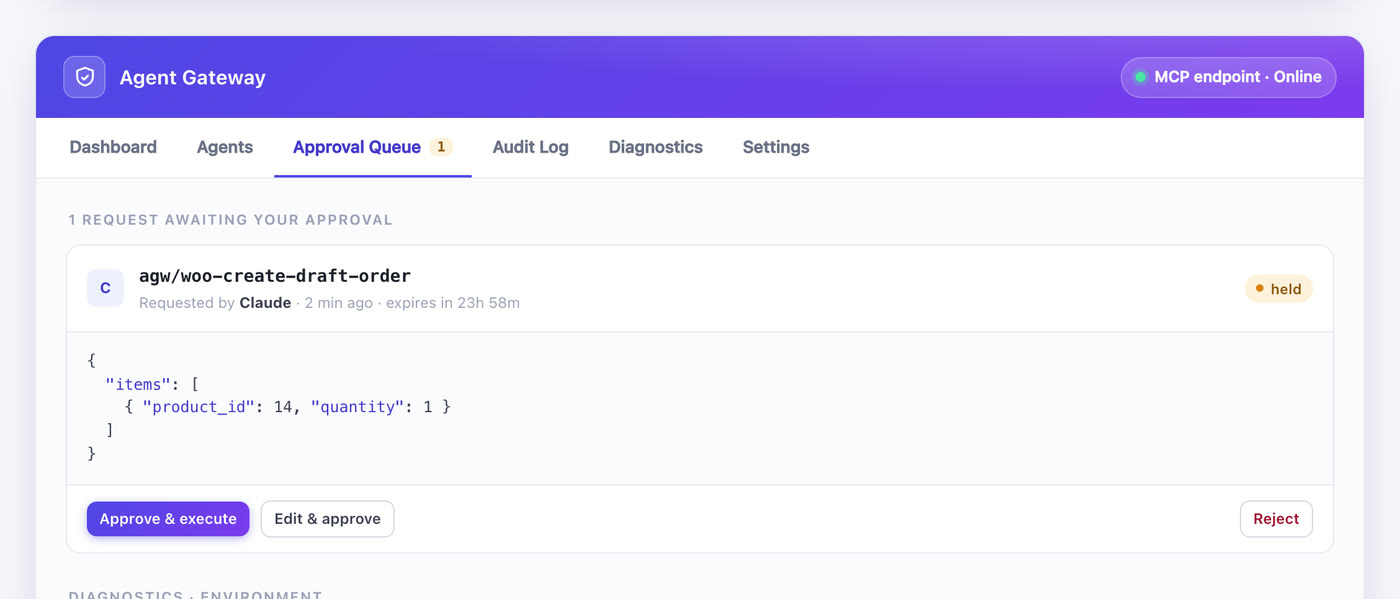
Why not just use a free plugin?
Almost every free “connect AI to WordPress” plugin funnels your store through a hosted service you do not control, so your catalog, orders, and customer data pass through someone else’s backend, and you pay a monthly fee forever. Agent Gateway is the opposite:
- You own every endpoint. Your OAuth server, your tokens, your database. Nothing leaves your domain and no third party ever sees your data.
- One purchase, not a subscription. No monthly SaaS fee, no per-agent pricing, no vendor lock-in.
- Open standards, not a walled garden. Built on MCP and OAuth 2.1, so any compliant client works today and you are never trapped in one vendor’s ecosystem.
- Governance built in, not bolted on. Per-ability permissions, an approval queue, a kill switch, and a full audit trail are the product, not an upsell.
Real OAuth 2.1, for self-hosted WordPress
Self-hosted MCP has been stuck on application passwords and hand-copied tokens. Agent Gateway brings the full standard to your own domain:
- PKCE (S256) authorization code flow, with exact redirect-URI matching.
- Dynamic client registration (RFC 7591) so clients onboard themselves.
- Protected-resource and authorization-server metadata (RFC 9728 / RFC 8414) for automatic discovery.
- Audience-bound tokens (RFC 8707) validated on every request, and revocation (RFC 7009).
- Opaque tokens stored only as hashes, never as JWTs, never in plaintext.
Built-in diagnostics
A one-click self-test verifies your discovery documents, that the Authorization header reaches WordPress, that credentialed responses are not cached, and a full register → PKCE → token → MCP → revoke round-trip, so you catch hosting issues before your AI clients ever do.
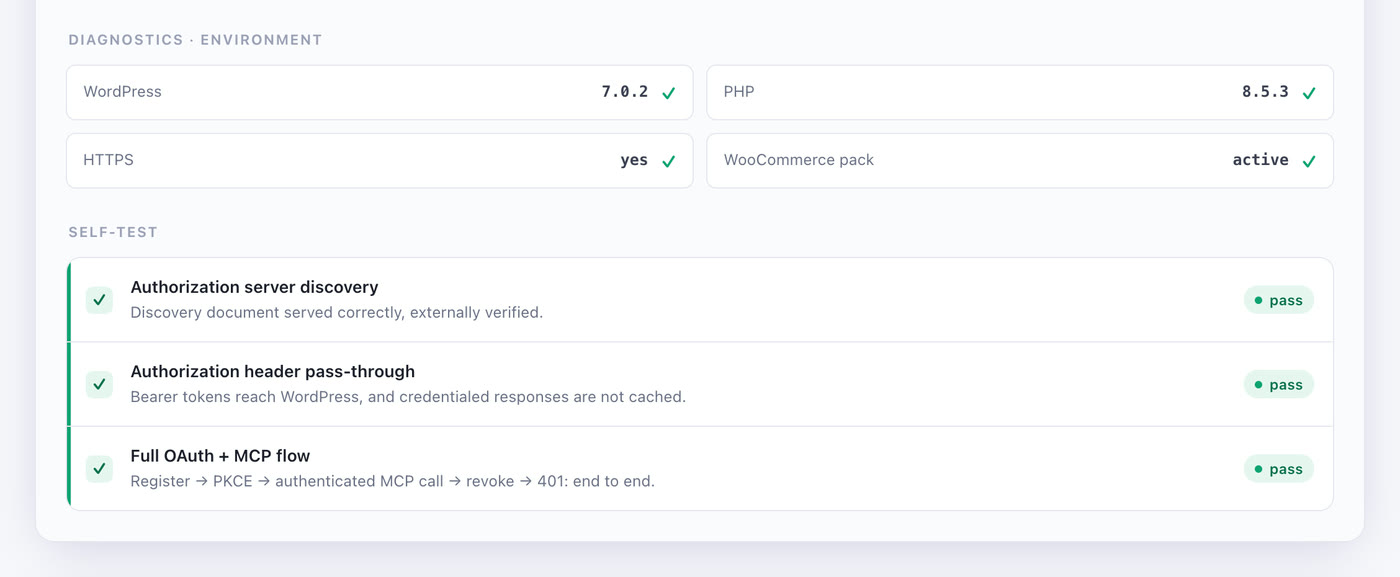
A complete, append-only audit trail
Every consent, tool call, hold, approval, and revocation is recorded: who did what, when, and with what outcome. Nothing an agent does is invisible.
Prebuilt WooCommerce abilities pack
Ship a working agent-commerce demo on day one. Read tools run instantly; writes wait for your approval:
- Search products, check stock, and estimate shipping
- Get order status, scoped to the agent’s own attributed orders
- Create draft orders and initiate returns (held for approval, and attributed to the agent, HPOS-safe)
Need your own actions? Register any ability with a filter and it flows through the same scope, grant, policy, and queue machinery automatically.
Works with
Claude (custom connectors), ChatGPT (connectors), Cursor, and any MCP client, plus the @automattic/mcp-wordpress-remote stdio proxy as a fallback. Targets the MCP authorization spec (revision 2025-11-25).
Requirements
- WordPress 6.9+ (Abilities API in core)
- PHP 8.1+, MySQL 5.7+ / MariaDB 10.4+
- HTTPS with a valid certificate
- WooCommerce (optional) for the commerce abilities pack
What you get
- The installable plugin, self-contained, with no Composer or build step
- Full HTML documentation and a quick-start guide
- Clean, opt-in uninstall
- GPLv2+ code; support via your CodeCanyon item page
Frequently asked questions
Is this a subscription?
No. Agent Gateway is a one-time purchase that runs entirely on your own server. There is no monthly fee and no hosted service to pay for.
Do I need to write any code?
No. Install the plugin, activate it, connect from your AI client, and manage agents, permissions, and the approval queue from the WordPress admin. Developers can extend it by registering their own abilities through a filter, but that is optional.
Does it require WooCommerce?
No. The core OAuth 2.1 and MCP layer runs on plain WordPress. WooCommerce is only needed for the prebuilt commerce abilities pack, which activates automatically when WooCommerce is present.
Is any of my data sent to a third party?
Never. There is no SaaS backend and no phone-home. Discovery, authorization, tokens, and every agent call happen on your domain and stay on your domain.
Will an agent get access to my admin account?
No. Each agent is its own zero-capability principal, completely separate from your WordPress users. You grant permissions per agent and per ability, and you can revoke them live at any time.
What stops an agent from doing something risky?
Write actions can be held for your approval before they run, you can auto-approve only within limits you set (for example a maximum order value), and a global kill switch plus per-agent dry-run mode let you pause or simulate everything instantly.
Which AI clients does it work with?
Claude, ChatGPT, and Cursor via their standard remote-MCP connectors, and any other MCP-compliant client. Because it is built on open standards, you are not locked to one vendor.
Do I get updates and support?
Yes. Updates are delivered through CodeCanyon, and support is available through your item page.
Changelog
== 1.0.3 (released 13 August 2026) ==

Initial release.
+ OAuth 2.1 authorization server: PKCE S256, dynamic client registration,
  protected-resource and authorization-server discovery metadata
  (RFC 9728 / RFC 8414), audience-bound tokens (RFC 8707), revocation (RFC 7009).
+ Agent principals with per-agent, per-ability permissions.
+ Human approval queue: auto-approve constraints, rate limits, global kill
  switch, and per-agent dry-run mode.
+ Append-only audit log of every consent, call, hold, approval, and revocation.
+ Built-in external self-test diagnostics.
+ Prebuilt WooCommerce abilities pack (search, stock, shipping, order status,
  draft orders, returns) with agent-attributed, HPOS-safe orders.
Secure by construction: all secrets are generated with a CSPRNG and stored only as SHA-256 hashes, compared in constant time; replaying a used code or refresh token revokes the entire token family; agent scopes can only ever map to virtual per-ability capabilities, never real WordPress capabilities.


&media=https%3A%2F%2Fs3.envato.com%2Ffiles%2F822975425%2F02-inline-preview-590x300.jpg&url=https%3A%2F%2Fwww.mediatags.de%2Fcodecanyon%2Fitem%2Fagent-gateway-ai-agents-for-woocommerce-wordpress-mcp-oauth-21%2F64737050?utm_source=sharepi)